Thursday, November 10, 2011

How to make a Great "First Impression"

How to make a great first impression

I believe making a " Great First Impression" is very important in building relationship with others. It is important because that very "first impression" can make a person to either like you or hate you.[ It's also important because it can help you to get a job if you can make a good first impression to your employer, to get a date, and make more friends ... ]


The reason why the " first impression" can make a person to either like you or hate you because--"It takes just a quick glance, maybe three seconds, for someone to evaluate you when you meet for the first time. In this short time, the other person forms an opinion about you based on your appearance, your body language, your demeanor, your mannerisms, and how you are dressed." -Mindtool.com


Mindtool also states that " the worst and could be the great things first impression is that it can be nearly impossible to reverse or undo" and " making those first encounters extremely important, for they to set the tone for the all the relationships that follows"

Therefore, it is very important to present or behave yourself good whether you are in business setting or at a social event; always make Good First Impression !!

Below are the tips that i get from the article, "Make Great First Impression", Mindtool.com:

<b> Be on Time</b>


" Someone you are meeting for the first time is not interested in your "good excuse" for running late. Plan to arrive a few minutes early. " -mindtool

--The very first thing to do in order to make a good first impression is being on time. Being on time or early by allowing your self panty of time to avoid unexpected thing happen on the way there-- delay traffics, making a wrong turn, or unable to find the address. In my case of making first impression for my interview at Bank of the West is I showed up 30 minutes early. I can tell that my manager was very impressed--he came to me with a big smile and acknowledge my effort of showing up on time.


<b>Be Yourself, Be at Ease</b></b>

"If you are calm and confident, so the other person will feel more at ease, and so have a solid foundation for making that first impression a good one" -mindtool.com

--Relating to my interview, my manager he was at ease and calmly asking me questions about my hobbies and my past job experience, He has helped me feel comfortable and I didn't feel nervous at all during the interview.

<b>Present Yourself Appropriately</b>

".. physical appearance matters. The person you are meeting for the first time does not know you and your appearance is usually the first clue he or she has to go on " -mindtool

" The key to a good impression is to present yourself appropriately.
They say a picture is worth a thousand words, and so the "picture" you first present says much about you to the person you are meeting" -mind tools

--I always make sure I look my best--going to the interview in my case. I prepared what I was going to wear a day before. I make sure everything look nice and neat, and decide on what to do with my hair and make up.

And make sure you dress apart-- While my week internship at real estate company, Friday dress code is business casual. I didn't know that and so I wear a business suit to work while everyone is in jeans and casual, it made me feel uncomfortable the whole day I was there 

<b>A Winning Smile</b>!

"Smile and the world smiles too.. A warm and confident smile will put both you and the other person at ease. So smiling is a winner when it comes to great first impressions. But don't go overboard with this – people who take this too far can seem insincere and smarmy, or can be seen to be "lightweights"--mindtool
that ''
- Smile while at the person you meet the first time. I think sometime if you don't smile at the person that you meet for the first time, they will categorize you as a not nice( or meany) person. or at least in my case when I was at an interview with a real estate company, the vice present of the procurement was there to observe the interview. the whole time she looks so serious and does not smile for once. I was so nervous, and making the person conducting the interview very nervous too.

 
<b>Be Open and Confident</b>

"...body language as well as appearance speaks much louder than words."

Use your body language to project appropriate confidence and self-assurance. Stand tall, smile (of course), make eye contact, greet with a firm handshake. All of this will help you project confidence and encourage both you and the other person to feel better at ease. And learn to control your nervous  by a little laugh or jitter.

<b>Small Talk Goes A Long Way</b>.

" Conversations are based on verbal give and take..take a few minutes to learn something about the person you meet for the first time before you get together.., " mindtool

small talk does lead the conversation --  when I first  walked in to the interview room for my recent job, I saw an 3d origami object hanging at one of the building window and I expressed my interest in it, we start out our interview by talking about Origami and hobbies. 

<b>Be Positive</b>

" Your attitude shows through in everything you do...maintaining an upbeat manner and a smile."
-Being positive can help you to be calm and able to help you to solve problem better.

ex.My employer said that I might not be  qualified for the job because they think that after I graduate in a month, i will quit their par-time job and look for a full time position --My positive response was to assure them that I can be able commit to the part time job for a year and hopefully I can grow within the company for a full time position.


<b>Be Courteous And Attentive</b>

" It goes without saying that good manners and polite behavior  help make a good first impression. ..anything less can ruin the one chance you have at making that first impression. So be on your best behavior!" - mindtool

"turn off your mobile phone" Your new acquaintance deserves 100% of your attention. Anything less and you'll create a less than good first impression.

By following these tips, I hope that you can make a good first impression where ever you go and to whoever you meet.

Good luck !

Tuesday, October 18, 2011

Unconcious mind - Blink

Blink by Malcolm Cladwell --The Power of Thinking Without Thinking
Blink was written by Malcolm Cladwell-- one of my other favorite book where Malcolm Cladwell introduces us to the new philosophy -- The power of thinking without thinking.
This book explains the process of how we make decisions in life using our "unconscious mind " V.S. "Conscious mind". "Unconscious mind" where "Blink" explained that we should "trust our first instinct". Malcolm explained that we have a computer like system that run within us that we draw conclusion in every situation that we are in ,and these information process very fast, [like high speed internet'] that were based on our life experiences. where we don't need to think about it but we already have the solution -- the power of thinking "without thinking".
In another word where Jonathan Lasser stated in his article as-- "Rapid cognition is the sort of snap decision-making performed without thinking about how one is thinking, faster and often more correctly than the logical part of the band stated train can manage. Gladwell sets himself three tasks: to convince the reader that these snap judgments can be as good or better than reasoned conclusions. The argue is that the decisions that we are able to formula in the blink of an eye" an Unconcious mind" that most people would think would take a long time to draw careful conclusion can just as accurately a second or a blink of an eye. This rapid cognition of an opinion where Colman refer as--thin slicing, where someone uses their past experiences and expertise to form an opinion. A person can thin slice without even knowing that they are thin slicing. The book talks about how our adaptive unconscious is able to not only start to make these decisions for us without us being consciously aware but also our adaptive conscious is also able to send messages throughout our body that allows us to began to react without being consciously aware of why we’re reacting in a certain way. An example that can relate to this from my experience is Multiple choice exam. Every time I take an exam, when there are time left, i always reread the questions and changed my answers. the result is that the answers that I changed are always incorrect. my initial answers would be the right. Blinks expalins that when we read the questions, our unconscious mine already running inside us and work to draw a conclusions, if we come back again and questions our answers, then our unconscious mind would be confused.
"Malcolm Gladwell" also discuss of 'thin slicing' is arresting-- In a psychological experiment, normal people given fifteen minutes to examine a student's college dormitory can describe the subject's personality more accurately than his or her own friends. A cardiologist named Lee Goldman developed a decision tree that, using only four factors, evaluates the likelihood of heart attacks better than trained cardiologists in the Cook County Hospital emergency room in Chicago:

Thursday, October 13, 2011

Peter Drucker-understand oneself

Managing Oneself by Peter Drucker
I always tell myself that nobody understand me better than I do, no body understand the reason why I act certain ways and do certain things, only me understand myself the best. However, I have never realized what is the meaning of “understanding myself” until I read the -- Managing oneself” by Peter Drucker. This has made me become self conscious that I have never really fully understood who I am. “The unexamined life is not worth living” by Socrates really get me thinking about how important it is to study and understand myself. I know that the first thing I need to do in order to become successful is to deeply understand who I really am and to learn how to manage myself. To learn what are my strengths and weaknesses as employees, a team member, a leader and what are my advantages and disadvantages. I also need to set up my personal plans and strategy, to marketing visibility plans about my brand, and to work on my SMART goals.
In the article “Managing oneself” Peter Drucker has brought up “The Five Most Important Questions”. Drucker’s questions are simple, but as is always found in Drucker’s writings, the simplicity is deceiving and the clarity of the questions forces you to reexamine your self. 1. What is my strength? 2. How do I perform? 3. What Are My Values? 4. Where Do I Belong? 5. What Should I Contribute? I have written a 20 pages self reflex based on this five questions and I have learn a lot about myself. So I believe after reading Peter Drucker article listed above and trying to answer the five Questions for yourself, you will truely understand who you are.

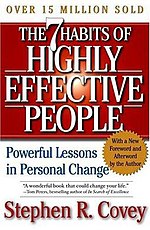
7 habits of effective people

The seven habits of highly effective people


This is a book I highly recommended everybody to read. This book is life changing for me-- Is beyond amazing ~ ! After reading this book, I have a totally different perspective about life and it totally helps me in developing my leadership skills in term of knowing my values, improve relationship with others, advance my working skills, and mostly understand what is important in life. According to businessball.com, this book is remarkably a set of inspirational and aspirational standards for anyone who seeks to live a full, purposeful and good life, and are applicable today more than ever, as the business world becomes more attuned to humanist concepts. 7 habits of effective people where Convey argues that life is made out of habits, and he is teaching us the 7 effective habits that will help us become successful in life. the Seven Habits of Highly Effective People are:
habit 1 - be proactive This is the ability to control one's environment, rather than have it control you--I often complain about how things doesn't go my ways, I am unlucky and ect.. but Convey explains that we can control our self and situation as long as we are proactive. EX. if I complain about how I don't have enough time to write blog-- a proactive action would be -- make time, plan, and prioritize.
habit 2 - begin with the end in mind Covey calls this the habit of personal leadership - leading oneself that is, towards what you consider your aims. What Convey also explains is that think of when you died. What do you want people to say at your funeral, what do you want them to remember you as? take time to deeply thinking about what you want other to remember you when you die will guide you to all the decisions you made early in life.
habit 3 - put first things first Covey calls this the habit of personal management. This is about organizing and implementing activities in line with the aims established in habit 2. Covey says that habit 2 is the first, or mental creation; habit 3 is the second, or physical creation.
habit 4 - think win-win> Covey calls this the habit of interpersonal leadership, necessary because achievements are largely dependent on co-operative efforts with others. He says that win-win is based on the assumption that there is plenty for everyone, and that if a decisions is not win-win situation for both then no deal should be done.
Habit 5 - seek first to understand and then to be understood Clear communication and empathy of listening is extremely powerful. Covey refer to as 'diagnose before you prescribe'. Empathy listening means that you should block everything from your mind and listen carefully what other have to say before you response. This is a skill not every body can archive but I rarely accomblished.
habit 6 - synergize Covey says this is the habit of creative co-operation - the principle that the whole is greater than the sum of its parts, which implicitly lays down the challenge to see the good and potential in the other person's contribution. habit 7 - sharpen the saw This is the habit of self renewal, says Covey, and it necessarily surrounds all the other habits, enabling and encouraging them to happen and grow. Covey interprets the self into four parts: the spiritual, mental, physical and the social/emotional, which all need feeding and developing.
www.businessballs.com website.

Saturday, October 8, 2011

How to train your body --to sleep

So last night, was one of my I called it " miserable night" I always have the miserable night. It sucks so bad. I can not fall as sleep. I am getting so tired and my energy drain out. I just wish I can be like a little kid and sleep like a little kid. Some night I just laying in bed and not able to fall asleep. I don't know if you guys have the same problems as me. I have talked to a few friends of mine and find out that they do have the same problem. So I have came up with this theory is that most college students have problem of sleep here and there. I think this is because of our schedule of working and going to school and also partying at night that has messed up our sleeping schedule.
So if you are college students and have the same problems like I do then trying to train yourself to a better sleep. Our human body is just like any kind of animal-- it can be trained and untrained. So if you do the following tips from about.com-- I have tried this and it helps to train my body back to sleep.
1. Only Sleep and Have Sex in the Bedroom The bedroom should be used only for sleep and sex. That means no reading in bed and no TV in bed. Doing these things (or anything else) confuses your body, making it difficult to fall asleep. Give yourself about 15 minutes to fall asleep. If you haven’t fallen asleep by then, get out of bed until you are sleepy. You can do some quiet reading (pick something boring), but avoid TVs and computer screens. Remember, your goal is to train yourself to fall asleep quickly. Reading a stimulating book, watching TV or doing anything else undermines that.
2. Keep a Schedule Go to bed and wake up at the same time every day. This will train your body to sleep on a schedule. If you can maintain this schedule for several weeks, you will probably find yourself falling asleep faster and feeling more refreshed. Do not sleep in on weekends or stay up late. Your body adjusts to changes in your sleep schedule at a rate of one hour per day. That means if you wake up at 6:30 a.m. on weekdays, but 8:30 a.m. on weekends, you need two days to adjust. You won’t be sleeping well again until Wednesday each week.
3. Make a Bedtime Ritual Create a nightly ritual to signal that it is time to sleep. Start the ritual about 30 minutes before you lie down to help release stressful thoughts and be ready to sleep when you lie down. A little quiet reading (not in bed) or a warm bath can be great. Avoid watching TV, since it stimulates your brain.
4. Exercise Daily Daily exercise will improve your chances of falling asleep quickly and sleeping deeply. Try to exercise early in the day and never within three hours of bedtime. Exercising too late in the day can make it difficult for you to fall asleep. A daily exercise habit will not only improve your sleep hygiene, but it will also improve your overall health.
5. Get Some Sunlight Sunlight helps regulate your circadian clock and make you feel sleepy at night by stimulating your body to produce melatonin (a hormone that regulates your sleep cycle). You need exposure to bright light every day. Morning sunlight exposure can be especially helpful. Be sure to open the drapes every morning to let light in.
6. Avoid Caffeine in the Afternoon Some people are caffeine sensitive and cannot drink any coffee, tea or other caffeinated beverage up to six hours before bedtime. If you are having trouble sleeping, try avoiding all afternoon and evening caffeine.
7. Make Your Bedroom Dark The contrast between light during the day and dark at night helps reinforce your body’s natural rhythms. By making your bedroom dark at night, you will be able to fall asleep faster and stay asleep longer. Closing drapes and doors can help reduce the light in your bedroom.
8. Avoid Alcohol That small glass of wine can make it more difficult to stay asleep. After an evening drink, you might fall asleep just fine, but you will likely wake up in the middle of the night. This effect is caused by a rebound in blood sugar and withdrawal from the alcohol after it is metabolized. Try avoiding alcohol before sleep and see if you sleep more soundly. For every drink you have, give your body at least an hour to process it before trying to fall asleep. 9.
The nicotine in cigarettes is a stimulant that will keep you awake, which is just one of the things that smoking does to your body. If you smoke, many resources are available to help you quit. The benefits quitting include better sleep, a longer life, more energy and saving money. Smokers also may wake up early due to nicotine withdrawal.
10. See a Doctor Finally, if these lifestyle changes don’t help, contact your doctor. You may have a sleep disorder or just may need some temporary help getting yourself in good ‘sleep shape.’ More on Improving Your Sleep

How to nail interview

How to nail an Interview Many of us in Senior positions are actively seeking for a job, and so prepare for an interview can become in handy. In my case of today, I just went through an interview, usually I would prepare a lot before hand so I do good in an interview. I don't want to look bad or mumbling when the employer asked questions that I could not answer. It is always nerve racking going to interview, however, I kinda like the feeling of it-- i like to be asked questions and selling myself and I know the more I go through the interview, the better I am at it. I have been to quite a few interviews, and most of the time, I did good-- I think. Even today, I think I did good too. But after going home from then interview, I feel like I could have done better
I forgot about the essential key of leadership, observe and Listen. I was trying so hard to sell myself during the interview, the manager said, "Serena I like the interview but the problems is that I am afraid you are graduating soon and we do not offer full time position in at least a year. I am staid you can not commit and we don't want to waste time training someone and after a few months they leave. " .. I did not really listen to his concerns. I was just going on and on how I can am a perfect candidate and I can perform the job well, I think I did not even trying to response to his concerns.

Monday, September 26, 2011

The Essence of Leadership Traits

What are the keys to become a great leaders ? 1-Develop a service of attitude -- customer is not a department , it's the attitude -- service is the life blood of any organization, everything flow from it and nourished by it. 2-Love what you do -- many things will catch your eyes, but few will catch your heart 3-Focus priorities -- Focus on critical few, not significant many 4-Understand the soft stuff-- there are things more important than money and sex-- recognition and praised 5-Build your brand --in the race of quality, there's no finish line 6-Embrace humor and optimism --optimism is the faith that lead to achievement 7-Commit to excellence -- excellence is not an act, It's and habit 8-Take risk-- don't be afraid to go. Out the limp, that is where the fruit is 9-Reinforce core values -- things that matter most must never mercy the things that matter least 10-Earn trust -- trust, not technology, is the issues of decade --Tom Peter 11-Take action -- you can not discover new ocean unless You have the courage to lose sight of the shore -- 12-Aim for the heart-- because they don't care how much you know, until they know how much you care